


Social value
Our purpose is to bring people and resources together to build a better world.

Social value defined Our approach
Our approach to social value differentiates BHP and is essential to the creation of long-term shareholder value
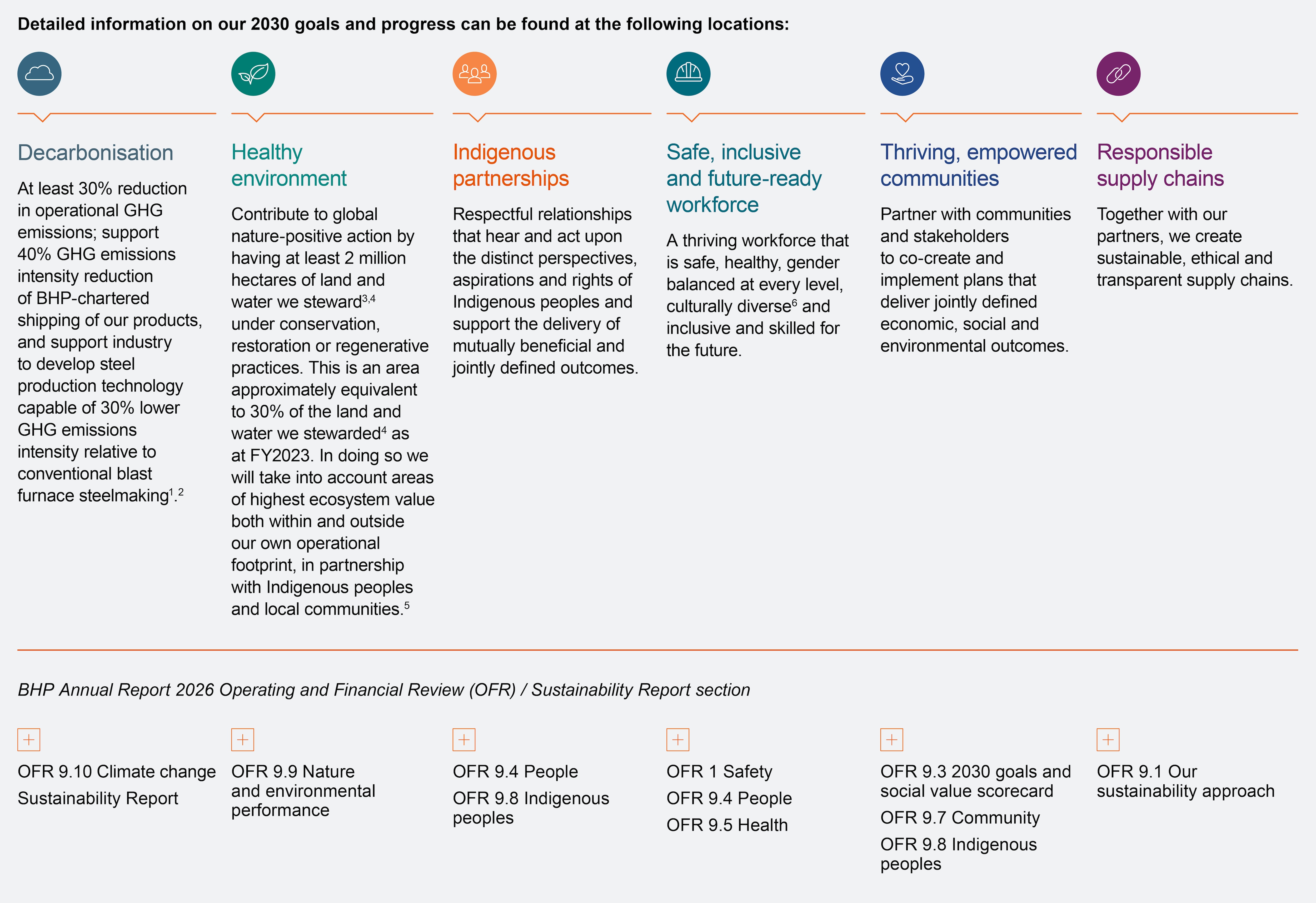
Our social value framework is focused on the six pillars of decarbonisation, environment, Indigenous partnerships, workforce, communities and responsible supply chains. Each pillar is anchored to an aspirational 2030 goal. Our 2030 goals provide opportunities for BHP to engage and work in partnership with others, and to build capability and co-create approaches to deliver positive outcomes and shared prosperity for people and planet.
To deliver on our 2030 goals, we have processes and systems in place to support decision-making and planning that embeds social value, including mandatory minimum performance requirements for investments and corporate alignment planning, supported by tools and guidance.
Our social value scorecard
Our social value scorecard’s 2030 goals and associated set of metrics and short-term milestones allow us to measure and transparently report progress.
Our metrics and milestones are evolving over time as our plans mature and we further understand the outcomes of our efforts. To demonstrate continual progress towards FY2030, new and existing milestones are planned, presented in the scorecard and reported against annually, but are not intended to represent the full roadmap to FY2030.
At its core, our scorecard represents an emphasis on partnerships, listening and co-creation, recognising it is not for us alone to decide what is of value to communities or the environment and addressing global challenges, such as climate change and nature loss requires collaboration.
Our full year performance in FY2026 against the scorecard is presented in the BHP Annual Report 2026 along with the revised and updated metrics and milestones for our FY2027 scorecard.
For more information on how the metrics and milestones support progress towards our 2030 goals and the methods we use to measure progress refer to the BHP ESG Standards and Databook 2026.
Footnotes
1. With widespread adoption expected post 2030.
2. For the definition of the terms used to express these positions, including ‘target’, ‘goal’, ‘net zero’, ‘carbon neutral’ and ‘operational GHG emissions’ refer to the BHP Annual Report 2026, Additional information 10.4. For more information on the essential definitions, assumptions, GHG emissions boundaries, measurement approach and adjustments for our targets and goals, refer to the BHP Annual Report 2026, Sustainability Report 5.2 Climate-related targets and 7 Basis of preparation, interpretation and GHG emissions calculation methodology.
3. It may include areas we stewarded for a period between FY2023 and FY2030 but have relinquished to a third party with the requisite expertise, and under conditions that create a high likelihood of durability of ongoing conservation, restoration or regenerative management practice.
4. Excludes areas held under greenfield exploration licences (or equivalent tenements), which are outside the area of influence of our existing mine operations.
5. During FY2026, BHP updated the wording of the Healthy environment goal. For more information on the updates and the reason for them refer to the BHP Annual Report 2026 OFR 9.9.
6. Cultural diversity in our workforce will be measured based on our substantive progress towards reflecting the cultural diversity of the societies where we operate.
| Detailed information on our 2030 goals and progress can be found at the following locations: | Website location for related topics |
| Decarbonisation | Climate change |
| Healthy environment |
Nature and environment performance |
| Indigenous Partnerships | |
| Safe, inclusive and future-ready workforce | |
| Thriving, empowering communities | |
| Responsible supply chains |